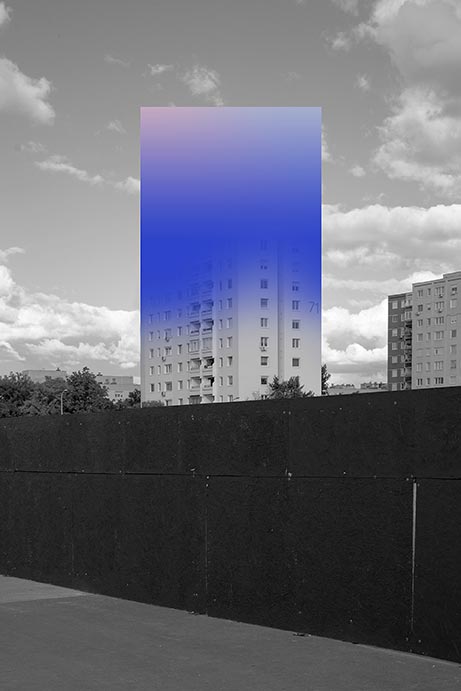
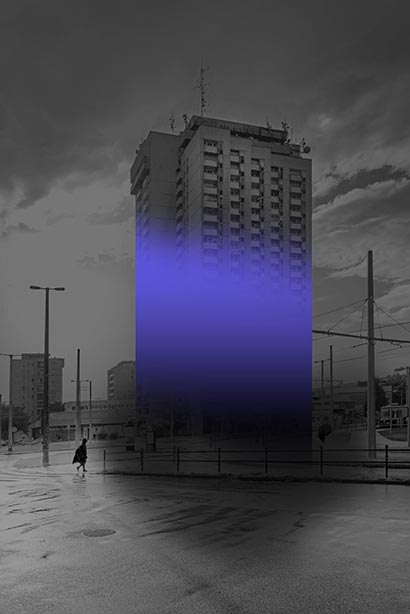
Balázs Csizik (1987, Székesfehérvár) obtained his master’s degree in Visual Communication (Budapest University of Technology and Economics) where he’s a lecturer now, in the fields of visual communication and communication technology. He combines the visual language of photography with other fine art forms, using different skillsets. His artistic vision is inspired by modern experimental architecture and art forms like suprematism and constructivism.
The common feature of his series is reduction, minimalism, which appears in colors, composition and visuals at the same time. This kind of reductivity also involves some distance, resignation in relation of the urban appearance displayed. In one of his series, he turns to the local phenomenon of post-socialist visual culture from a global viewpoint. In his works, he uses custom made materials, like plywood objects and textile elements with organic surfaces of natural substrates. The main visual is based on the handmade artificial world and the interplay between nature and built elements. This is accompanied by the duality of digital and analogue technical solutions within his art. In his series, he experiments with the relations between rough urban elements and nature – he also experiments how he can change the weight and form of the different kind of urban materials with the use of natural elements to give new feelings about the inhuman and brutal materials like concrete.